
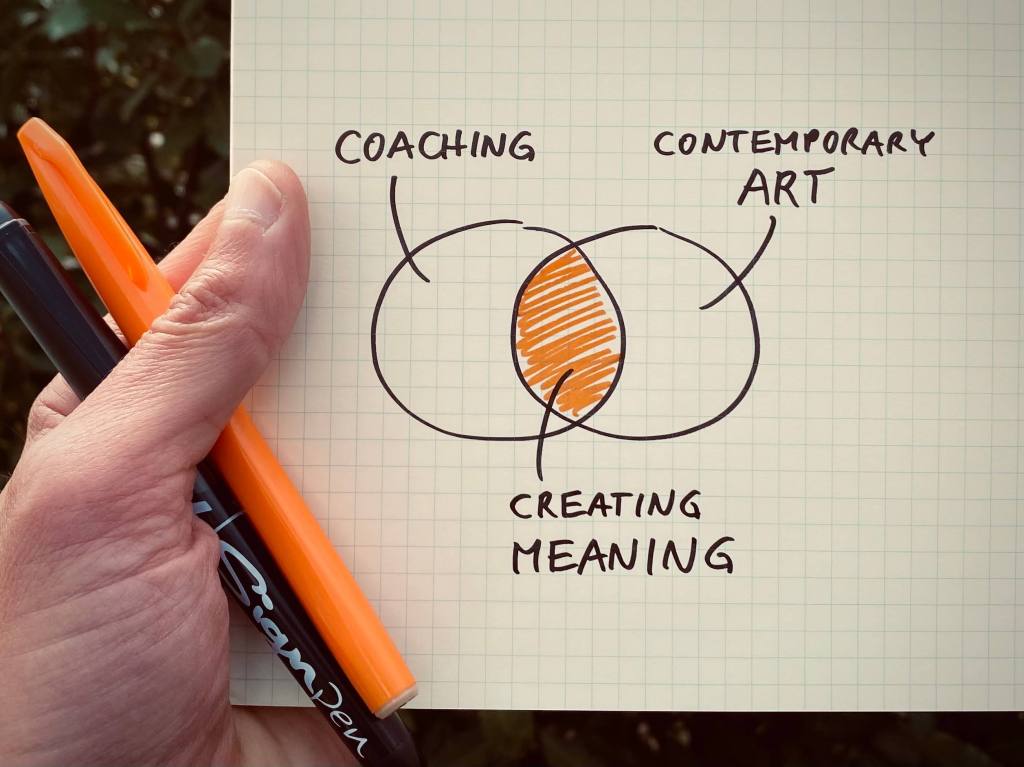
Should we send leaders to art school? Would artists make great coaches? Is coaching essentially an artform?
A few years ago the British artist Grayson Perry wrote the acclaimed book, Playing to the Gallery, to demystify contemporary art. What struck me in this book is how often you could simply swap the word ‘art’ for coaching.
Here are some of his quotes.
On what artists do
The book recounts an encounter with a child who was once asked, what do you think contemporary artists do? According to Perry, the response was perfect: “They notice things.”
— sound familiar? As coaches we notice things and we help our clients notice things.
On creating meaning
According to Perry, “art’s primary role is to make meaning.” He goes on to quote the neuroscientist Raymond Tallis: “Art is expressing one’s universal wound of living a finite life of incomplete meanings.”
— you don’t have to be an existential coach to relate to this. Coaching is about helping clients make sense of things and find their own meaning. And as coaches we find meaning in our work.
On being part of the system
“Creative rebels often like to think they offer an alternative to the capitalist system… what they don’t realise is that they are playing into capitalism’s hands because the life blood is capitalism is new ideas. Contemporary art is like an R&D department for capitalism.”
— I often ask myself if we as coaches truly help our clients change systems, or do we merely reinforce existing systems and power structures? Are we part of the problem or the solution?
On the power of acceptance
Perry believes that young people who go to art college find themselves truly accepted there – often for the first time in their lives. “To come within the tolerance and accepting embrace of the art college is a profound experience.”
— replace ‘art college’ with coaching, and we have a description of the client-centred approach which underpins all coaching. For clients to feel seen and accepted for who they are is foundational. And as coaches we tend to experience the same embrace in our coaching communities.
On learning new skills and ‘relaxed fluency’
“Skills are really important to learn… When I learn a new technique my imaginative possibilities have expanded… I like the idea of ‘relaxed fluency’ when you’ve become really skilful.”
— ‘relaxed fluency’ is a fabulous turn of phrase, so much better than mastery! Skills are the foundation of good coaching practice but, as we mature as coaches, we gently let go of tools and techniques to work more intuitively and emergently… with relaxed fluency!
On safe thinking spaces
“The metaphor that best describes what it’s like for my practice as an artist is that of a refuge. A place inside my head where I can go on and process the world and its complexities.”
— it’s the same with coaching: a safe space to process complex thoughts.
So there you have it.
Coaching is essentially an artistic process, even for those of us who don’t often use creative techniques with clients – it’s how we go about it. Coaching is a craft and we help our clients make their own art – whether that’s leadership, business, life, or indeed a colourful doodle on a piece of paper.
Conversely, would artists make good coaches? I recently saw Grayson Perry’s TV documentary on AI and the future. He is a fantastic interviewer – curious, kind, witty and challenging. I’d have him as a coach any day.
Maybe artists and coaches have more to learn from each other than we realise.

