
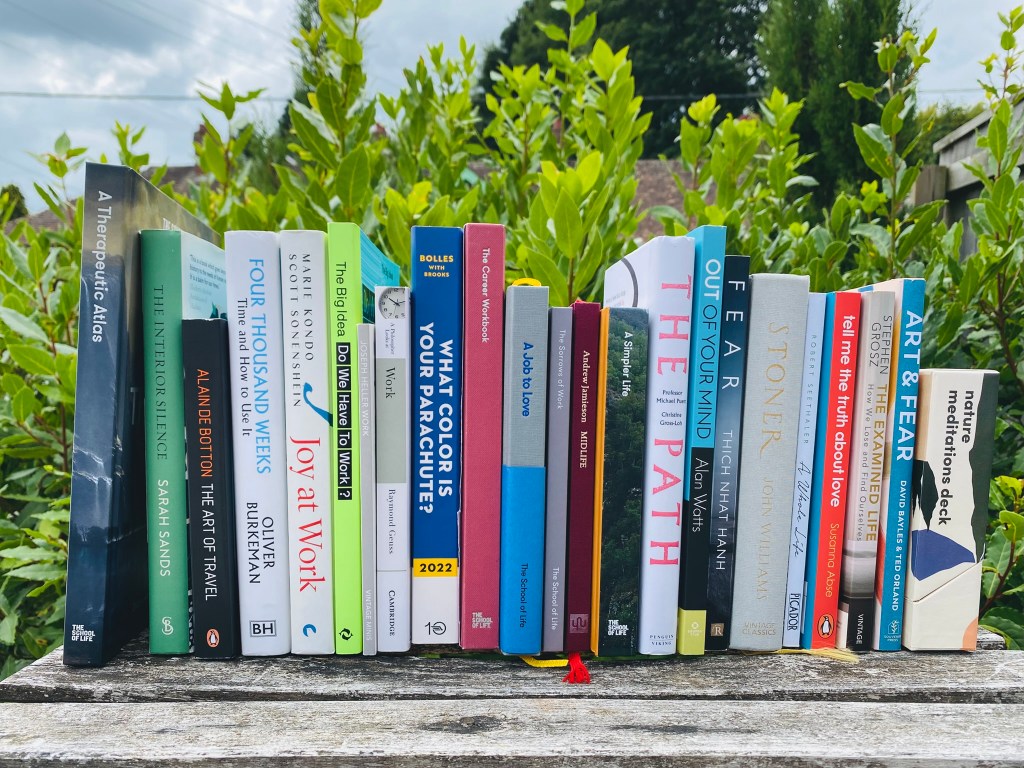
The summer holidays are a great time to reflect on what we want from our lives and careers. Below are some books and ideas I have found helpful over the years – and some to avoid! – collated into 10 themes.
1. When basic questions don’t work anymore
When we feel a bit stuck in the middle of our careers and lives, questions like “what does success look like for you?” don’t really cut it anymore. By this stage we’ve got plenty of experience, so if we knew the answer we wouldn’t need to ask the question.
This makes me hesitate to recommend career bibles like What Colour is Your Parachute, even if they’re quite good. Books like these offer a structured approach to narrowing down our aspirations and job searches. While this can be helpful to frame our thoughts, it is a bit mechanistic and evades deeper questions that may be the real issue behind feeling stuck or just a bit ‘meh’ about our situation.
Especially by the time we reach our 40s or 50s, questions like “what do I really want from the rest of my life?” become much more pertinent. To answer these, we need to go both broader and deeper. Which brings us to the next point.
2. The search for meaning
The midlife crisis has long been derided as the stuff of fast cars and illicit affairs. But as Andrew Jamieson argues in his book, Midlife: Humanity’s Secret Weapon, it is a necessary transformation fulfilling some deep evolutionary needs. The process can be slow or sudden, painful or enriching, and comes in many different incarnations. The book provides many examples of famous people, from Michelangelo to Marie Curie, who were late bloomers thanks to embracing their midlife transformation. No red Ferrari required.
Over the years I have taken much inspiration from a growing library of books published by The School of Life, founded by Alain de Botton. Written by philosophers and psychotherapists, books such as A Simpler Life, A Job to Love, or The Career Workbook take a much more human and rounded approach than the average career advice tome.
For example, what things did you enjoy as a child? What does that tell you about what’s currently missing in your life? How could you channel more of that into your career? Questions like these require us to put in some inner work… ChatGPT won’t be much use here.
3. The trap of productivity
The Marie Kondo method of decluttering your life also has its limits. Yes, I found it liberating when downsizing – but her book, Joy at Work, which applies the same principles to office life, is at times unintentionally funny: ridding our work laptops of anything that does not ‘spark joy’ may well have less joyful consequences than intended.
Oliver Burkeman’s book, 4000 Weeks: Time and How to Use it, offers better advice. Having learned that we’ll never get to the end of our task lists no matter how smart our productivity hacks (in fact, they can make it worse), he suggests better alternatives for a more meaningful life which, on average, is 4000 weeks long – hence the title. For example, we can learn from the way farmers approach their work: it’s never done, and we can’t make hay while it’s raining. It’s about working with things, not against them, and finding satisfaction within that. There is no point in shouting at clouds.
4. Finding inspiration in travel
If you find it difficult to just sit down and reflect, travelling can be a great source of inspiration. (You may even be reading this while on holiday.) To make more meaningful use of your travel time, books such as The Art of Travel or A Therapeutic Atlas may provide useful and surprising pointers.
Conversely, if you are craving stillness, The Interior Silence by Sarah Sands describes her experience of visiting beautiful monastic retreats around the world. Even without going there I found the book calming and illuminating.
5. On facing our fears: lessons from artists and Zen monks
We can also ask ourselves what an artist would do in our position. An artist’s life is inevitably precarious. As the book Art and Fear describes, fear is never far from creativity – in fact, it is necessary. Creating new things demand that we step outside our comfort zone. The alternative is comfort and status quo. We can’t have it both ways.
Fear can be creative fuel, but it can also paralyse us. In which case Thich Nhat Hanh comes to the rescue with his classic, Fear: Getting Through the Storm. I found this book soothing and empowering when, earlier in my career, I was facing redundancy with a mortgage and two kids.
6. Escape into fiction
Speaking of art, literary fiction can also help us reevaluate our careers and lives. Fiction widens our world and puts things in perspective. The novels Stoner and A Whole Life both describe someone’s life from cradle to grave. They made a big impression on me. Here, ordinary lives of ups and downs are subtly but powerfully revealed as beautiful and extraordinary. My takeaway: to have a meaningful life there is no need to achieve anything ‘big’. Therefore, how important should a career really be? What even is a career?
7. Questioning the system
The previous point leads us to probing the very nature of what we call ‘work’. If you feel inclined to question the wider systems in which we operate, books like The Big Idea: Do We Have to Work? or A Philosopher Looks at Work or The Sorrows of Work are great starting points. For example, anthropologists have shown that hunter gatherers had a much higher quality of life than we have today. Why are we burning ourselves out in the name of so-called progress and the conquest for always more? Who are we doing it for? At what cost? What is ‘enough’?
For something more light-hearted, Joseph Heller’s Vintage Mini book, Work (extracted from the novel, Something Happened) takes an acerbic look at the grinding madness of corporate culture in the early 1970s… it’s shocking how little has changed since then.
8. Work, life and the universe
Over the years I have also found much wisdom and inspiration from a range of popular titles spanning eastern philosophy, stoicism or existentialism. This very much depends on personal preference, so I won’t recommend anything too specific here. But I do love my Nature Meditations Deck. Nature is an apt metaphor for the ups and downs of (business) life, encouraging us to embrace an abundance mindset but also the need for acceptance, rest and renewal. That really floats my boat. What about yours?
9. The hidden lessons of relationships
Finally, psychotherapists would argue that our relationships are an important source of meaning for us. I often refer to relationships as ‘triangulation’ for our lives and careers. (This is also supported by systems thinking which recognises that, in an interconnected world, relationships between entities are more important than the entities themselves. But I digress.)
If psychoanalytic insights tickle your interest, books like The Examined Life: How We Lose and Find Ourselves or Tell Me the Truth About Love are a joy to read. Both written by therapists, they eloquently describe client case studies from all walks of life. It’s difficult not to recognise ourselves in some of these stories – and learn something in the process.
10. Onwards
Ultimately, we are the stories that we tell ourselves. In that spirit, the most important question may be, “how do I want to be remembered by those who matter to me?”
None of the answers are easy. It requires self-reflection, feedback, honesty and a small dose of bravery. But the answers are somewhere within us. We just need a door to access them – maybe through a good book, an inspiring trip, or an unexpected encounter.
Alternatively, working with a coach can accelerate this process. You have the answers; a good coach helps you find them. And they may surprise you. Contact me if you’d like a chat to find out more.
In the meantime, happy holidays ☀️⛵🌴🏔️
What are you taking away with you?
 True Horizon Coaching